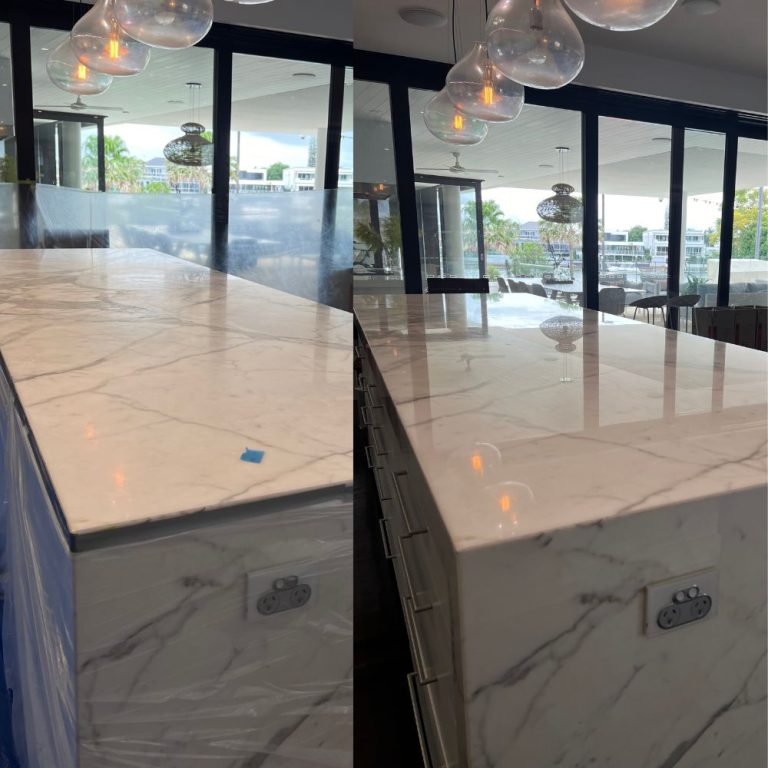


How To Fix Chips In Marble Benchtops
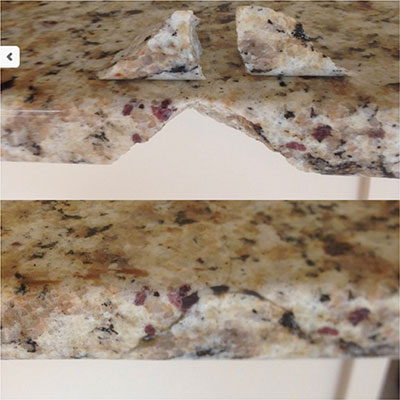
Most chips in marble benchtops can be repaired. A lot of chip repairs are on the side corners or edges of the benchtop, because that is where they normally get knocked.
The chip is usually filled with a two-pack epoxy, mixed to get a colour that suits the benchtop, or with a gel that can be cured with UV light. Once that has set, the repair is shaped with fine emery paper, worked through the grades, then finished with polishing paste until it has the same shine as everywhere else.
Where Do Marble Benchtops Usually Chip?
Most chip repairs are done on benchtops, and most of them are on the side corners or edges.
That is because the edges take the knocks. Someone might bump a pot, pan, plate, bottle or appliance into the side. Corners are also more exposed, especially on island benches, bathroom vanities and kitchen benchtops where people are working around them all the time.
You can also get chips around sink cut-outs, cooktops and areas where the stone is thinner or more exposed.
What Causes Marble Benchtop Chips?
Marble can chip from impact. It is usually from something being dropped, knocked or dragged against the edge.
Common causes include:
- Dropping something heavy on the benchtop
- Hitting the edge with a pot or pan
- Bumping appliances into the marble
- Knocking the corner with a hard object
- Older small chips getting worse over time
It does not always take a huge impact. If the edge is exposed, or if there is already a weak point there, a small knock can be enough to chip it.
How Marble Chip Repair Works
The first thing is to look at the chip and work out what type of repair is going to suit it.
If it is an edge or corner chip, you normally need to rebuild that missing section. That can be done with a two-pack epoxy. The epoxy is mixed to get a colour that suits the benchtop, then it is placed into the chip and allowed to set.
In some cases, a gel can be used instead. That gel is cured with a UV light. Once the UV process is done, the repair is hard enough to shape.
Then you use fine emery paper to shape the repair and bring it back to the edge or surface. You work through the grades so it is not left rough or uneven. Once it has been shaped properly, polishing paste is applied and the repair is polished until it has the same shine as everywhere else.
The repair is not just filling the hole. It has to be shaped and polished properly, otherwise it will just look like a blob sitting on the marble.
Two-Pack Epoxy Repairs
Two-pack epoxy is commonly used for marble chip repairs. It is useful because it can be mixed and coloured to suit the benchtop.
This is especially helpful when the chip is on an edge or corner and you need to rebuild the missing part of the marble. Once the epoxy sets, it can be shaped, smoothed and polished.
The colour matching is important. You are trying to get the repair as close as possible to the marble around it, so it does not jump out when you look at the benchtop.
UV Gel Repairs
Another option is a gel that can be cured with UV light. This can be used for certain chips, depending on the size and position of the damage.
Once the gel is applied, it is cured with the UV light. After that, the same idea applies. The repair still has to be shaped with fine emery paper, worked through the grades, and polished so it blends into the surrounding surface.
Can The Repair Be Colour Matched?
Yes, the repair material can be colour matched to suit the benchtop, but you have to be realistic.
Marble is natural stone. It is not one flat, perfect colour. Some marble has veining, movement, different tones and different patterns running through it. So you try to get the colour as close as possible, but it may not be completely invisible in every case.
If it is a small chip on a simple edge, it can often blend in very well. If it is a bigger chip or it sits across a vein, it can be harder to hide completely.
The main thing is to make the repair neat, smooth, strong and polished so it does not stand out badly.
Can You Fix A Marble Chip Yourself?
You can buy DIY repair kits, but the hard part is not just filling the chip. The hard part is making it look right afterwards.
If you get the colour wrong, it can stand out. If you overfill it, you have to shape it back. If you use the wrong paper or polish, you can scratch the marble around it. And if the marble has a polished finish, it can be difficult to get the repaired area to match the same shine.
For a tiny chip in a low-visibility area, a DIY kit might improve it. But for a visible edge, corner, benchtop or vanity, it is usually better to have it repaired properly.
Will The Marble Chip Repair Be Invisible?
Sometimes it can be very hard to see, but not every repair will be invisible.
It depends on the marble. It depends on the chip. It depends on the colour and the veining. It also depends on where the chip is and how the light hits it.
A good repair should make the chip look much better. It should feel smooth, it should not catch on cloths or hands, and it should have a shine that matches the rest of the stone as closely as possible.
But no one should really promise that every chip repair will disappear completely, because marble is natural and every piece is different.
What Happens If You Leave A Chip Unrepaired?
If you leave a chip, it can keep catching on things. It might catch on a cloth when you are wiping the bench. It might catch your hand. It can also hold dirt and moisture, which makes the damage more noticeable.
On an edge or corner, the chip can sometimes get worse if it keeps getting knocked. A small chip can turn into a bigger one.
Repairing it early usually gives you a better chance of keeping the repair smaller and neater.
How To Help Prevent Marble Benchtop Chips
The main thing is to be careful around edges and corners.
Do not knock heavy pots, pans or appliances into the edge. Do not drag heavy items across the marble. Use chopping boards, trays and placemats where needed. Be careful around sink and cooktop cut-outs, because these areas can be more vulnerable.
When To Call A Professional
It is worth calling a professional if the chip is on a visible edge or corner, if the missing piece is large, or if the marble has a polished finish that needs to be matched.
You should also get it looked at if the chip is near a sink, cooktop or cut-out, or if someone has already tried to fill it and it does not look right.
A proper repair is about more than filling the chip. It is about getting the colour right, shaping the edge properly, working through the grades, and polishing it so it sits with the rest of the benchtop.
Contact Marble Everlast
Need help restoring, polishing or protecting your marble, stone or terrazzo surfaces? Speak with the Marble Everlast team today.
More from the Blog